Maximizing Productivity with Generative AI
“Great job of breaking it down and progressing through examples- it was helpful to digest and then practice! I actually was able to solve a real problem I have been fighting with for months!”
Custom Learning at Northeastern
The Roux Institute delivers customized, instructor-led learning experiences that help organizations close skill gaps, apply new tools, and make progress on real business challenges.
Generative AI results are based on a learner follow-up survey conducted two months after a Maximizing Productivity with Generative AI workshop.
Choose your starting point
Start with the need that matters most. We can customize the content, format, and learning sequence around your workforce and priorities.
Help employees apply AI tools safely and productively in their everyday roles and workflows.
Explore training → 02Build the shared understanding leaders need to guide teams, investment, and organizational change.
Explore training → 03Give teams a structured way to evaluate and prioritize potential AI use cases.
Explore training → 04Translate AI principles into practical guidance, governance, and decision-making processes.
Explore training →Beyond training
Northeastern brings workforce learning, graduate talent, applied AI, and research together. As your needs develop, we can help move from capability building to governance, use-case development, prototyping, implementation, or custom research.
Partner feedback
Participants leave with practical methods, frameworks, and skills they can apply to real work.
Maximizing Productivity with Generative AI
“Great job of breaking it down and progressing through examples- it was helpful to digest and then practice! I actually was able to solve a real problem I have been fighting with for months!”
Maximizing Productivity with Generative AI
“Very engaging - leaving course with tangible skills that I can use right away and also with concepts that can be applied broadly.”
Maximizing Productivity with Generative AI
“Applicable knowledge and skills that can be leveraged immediately.”
Evaluating AI Opportunities
“Practical way to break down potential AI use cases that could benefit the organization.”
Identifying AI Opportunities
“Really helpful and practical framework which supported engaging conversations in the breakout rooms.”
Maximizing Productivity with Generative AI
“The examples for the exercises were very applicable to my job, and I realized tasks AI could assist with that I was not already utilizing it for.”
Evaluating AI Opportunities
“I like that it broke the process of analyzing an AI opportunity down into practical steps. It’s been difficult to know where to start.”
Maximizing Productivity with Generative AI
“Interactive and engaging with the ability to ‘practice’ on relevant projects to my work.”
Use the arrows, swipe, or scroll horizontally to see more comments.
Free AI resource
Download Zach’s AI Prompt Engineering 101 Guide, a quick-start PDF with practical strategies, examples, and frameworks to help professionals get better results from AI tools.
Why organizations choose our training
Our programs are designed for direct application, live engagement, and organizational relevance. That means learners work with real scenarios, relevant tools, and guided practice that connects back to the work they do every day.
Participants apply what they learn directly to day-to-day work instead of sitting through passive lectures.
Live instruction, discussion, hands-on activities, breakouts, and feedback keep learners engaged.
Courses can reflect your business priorities, roles, tech stack, data environment, and industry scenarios.
Northeastern faculty and staff bring academic depth into programs designed for workplace application.
Support one team, one function, a leadership cohort, technical staff, or broader workforce capability building.
We collect and share learner feedback to help evaluate program effectiveness and inform next steps.
Training comparison
Many options introduce AI, data, and digital topics. Roux custom learning is designed to connect live instruction, customization, and practical application to the realities of your organization.
| What to compare | Northeastern Custom Learning | Self-paced online courses | Generalist training vendors | No Training Support Provided |
|---|---|---|---|---|
| Customized to your organization | ✓ Built around your goals, roles, and context | – Usually standardized | ◐ Some tailoring | ◐ Left to individuals to seek upskilling |
| Live expert faculty instruction | ✓ Facilitated collaboration, discussion, coaching, and Q&A | – Typically solo learning | ◐ Atypical | - Not applicable |
| Applied to real workflows | ✓ Designed to change the way teams approach real challenges | – Often one-size-fits-all | ◐ May not reflect your workflow | ◐ Skills learned for generic application |
| Role-based learning paths | ✓ Supports leaders, technical staff, business teams and end-users | ◐ Some options exist | ◐ May not reflect actual use cases | – Possible for self-motivated individuals |
| Broader AI readiness support | ✓ Aligns with adoption and workforce goals | – Standalone learning | ◐ Sometimes connected | – Not scalable |
We can help you decide what makes sense for your audience, goals, tools, and current level of AI or data maturity.
Our approach to AI readiness
AI readiness is not built through one-off courses or tool access alone. Organizations need shared understanding, practical application, and support structures that help teams use AI responsibly and effectively in their daily work.
Leaders and teams need a common language for AI, data, risk, opportunity, and responsible use. This foundation helps organizations make better decisions and reduces confusion across functions.
Training should connect directly to the roles, workflows, tools, and business challenges employees already face. That is where AI moves from abstract concept to practical capability.
AI capability grows when organizations pair training with leadership alignment, responsible use guidance, peer learning, measurement, and continued support after the first session ends.
We help organizations move from awareness to applied use by tailoring programs to the audience, maturity level, tools, business priorities, and adoption goals.
In a recent cohort, post-training confidence reached 83%–97% across measured AI skill areas, including RAG, AI agents, system prompts, LLM memory, and personalization settings.
Based on learners who completed both the pre-survey and post-survey. Pre-training confidence ranged from 0%–41%.
We do not start with a generic course and hope it fits. We work with partners to assess needs, recommend learning paths, customize content, deliver live learning, and evaluate participant feedback.
We begin by understanding your organization’s goals, roles, skill gaps, priorities, and learning constraints.
We identify course progressions and learning experiences aligned to your business priorities and workforce needs.
We customize content with your input so examples, tools, and scenarios feel relevant and useful to learners.
Programs are scheduled around your team’s capacity and designed to prioritize practice, discussion, and application.
Participant feedback helps evaluate the experience and inform future training, expansion, or follow-on support.
Course catalog
Courses can be customized for different levels, departments, and roles. Explore common starting points below, then download the full catalog for more options.
Help leaders build shared AI fluency, understand opportunity areas, and make better decisions about adoption and investment.
View course →Give teams a structured way to identify, evaluate, and prioritize AI opportunities tied to business value.
View course →Help employees use generative AI tools more effectively, safely, and consistently in everyday workflows.
View course →Support teams responsible for deploying AI in ways that maximize positive impact, reduce risk, and address emerging regulations.
View course →Align leaders around the strategic and operational pillars needed to become a more data-driven organization.
View course →Help functional teams ask stronger questions, interpret data, and use insights to drive business decisions.
View course →Build technical capability in Python-based machine learning for predictive and prescriptive data modeling.
View course →Support developers in using AI-assisted coding tools more effectively inside real engineering workflows.
View course →Help project managers and team leads strengthen planning, communication, stakeholder management, risk management, and execution.
View course →See the broader catalog of AI, data, analytics, responsible AI, software, and project management courses available for customized delivery.
Frameworks
Our custom learning team uses practical frameworks to help organizations move from broad interest to clearer priorities, targeted upskilling, and measurable business value.
A practical framework to help organizations evaluate AI opportunities through strategic questions, moving from reactive experimentation to clearer value delivery.
Explore the framework →A workforce capability framework that maps current skills against future needs and helps identify targeted upskilling recommendations by role.
Explore the framework →Custom Learning
Exploring AI, data, or technology training for your organization? Connect with our team to discuss custom programs, role-based learning, and practical ways to help employees apply new skills in their work.
Custom Learning Expertise
Our programs are shaped by Roux Institute practitioners working across AI adoption, data literacy, workforce transformation, responsible use, and practical implementation.
AI Adoption, Data Literacy, and Responsible Use
Berkeley helps teams understand how AI and data tools can support real workflows, better decision-making, and practical adoption.
Workforce Transformation, AI Strategy, and Intrapreneurship
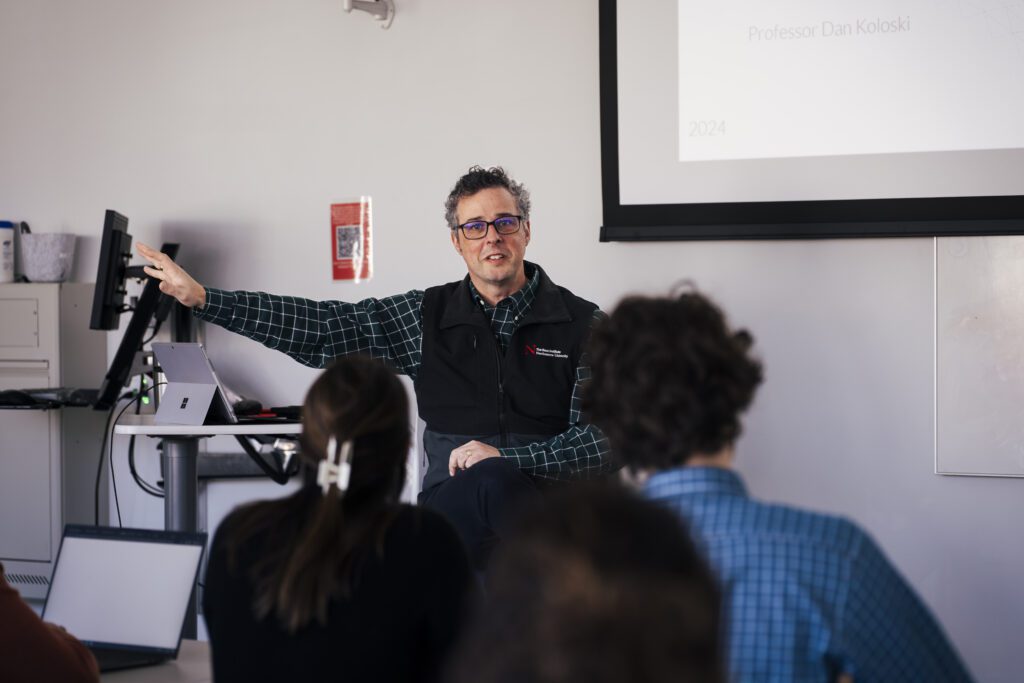
Dan focuses on helping organizations build AI and data capability from within by connecting learning, innovation, and workforce strategy.
FAQs
Reach out to the custom learning team. Programs can be shaped around your organization’s specific needs, roles, tools, and priorities.
Course length can range from short workshops to more in-depth learning experiences, depending on the topic, audience, and amount of applied work needed.
Many virtual classes can run as cohorts of up to 50 learners, though smaller groups may be recommended depending on the content and goals.
Courses support employees from frontline staff to executives, including technical, non-technical, functional, and leadership audiences.
Many learning experiences include a digital badge that learners can share as a visual micro-credential.
Maine-based employers may be able to explore workforce training funding through the Harold Alfond Center Workforce Development Grant.
Start with a short conversation about your team, goals, and learning needs.
Partner outcomes
Organizations work with Northeastern to build shared AI understanding, strengthen role-specific capabilities, and connect learning to broader adoption and implementation efforts.
increase in reported employee generative AI use
A two-year initiative combined workforce assessment, custom AI and data literacy training, graduate talent, and applied AI support.
executives engaged in customized AI learning
A two-part learning experience helped executives build a shared understanding of AI and practice prioritizing potential AI investments.
employees supported across roles and levels
Six tailored learning experiences helped employees apply AI within their roles and supported a lean internal technology team.
We can help you identify the right audience, learning sequence, delivery format, and opportunities for continued support.
Responsible AI Education
Responsible AI is not only a policy conversation. It requires shared language, practical decision-making, governance structures, and role-specific training for the people building, buying, managing, and using AI systems.
Northeastern’s Responsible AI education helps organizations move beyond high-level principles and build the skills, structures, and practices needed to manage AI responsibly.
Explore Responsible AI PracticeBuild shared understanding of AI risk, oversight, accountability, and governance so leaders can make better adoption decisions.
Help teams translate Responsible AI principles into workflows, review processes, deployment gates, and evidence-based decision-making.
Train teams to identify, evaluate, and document risks related to fairness, robustness, explainability, privacy, safety, and intended use.
Support employees using generative AI with practical guidance around privacy, accuracy, human oversight, bias, and appropriate use.
Responsible AI education can be delivered as stand-alone training or paired with broader AI strategy, governance, workforce development, or applied AI initiatives.

This course equips leaders with an actionable blueprint to drive RAI strategy and advance their businesses in the digital age. Ideal for those leading company strategy, digital transformation, or innovation initiatives.
View Course
Explore the ethical and technical foundations of generative AI and learn best practices for its responsible integration. Ideal for individuals seeking to navigate AI development and deployment responsibly.
View Course